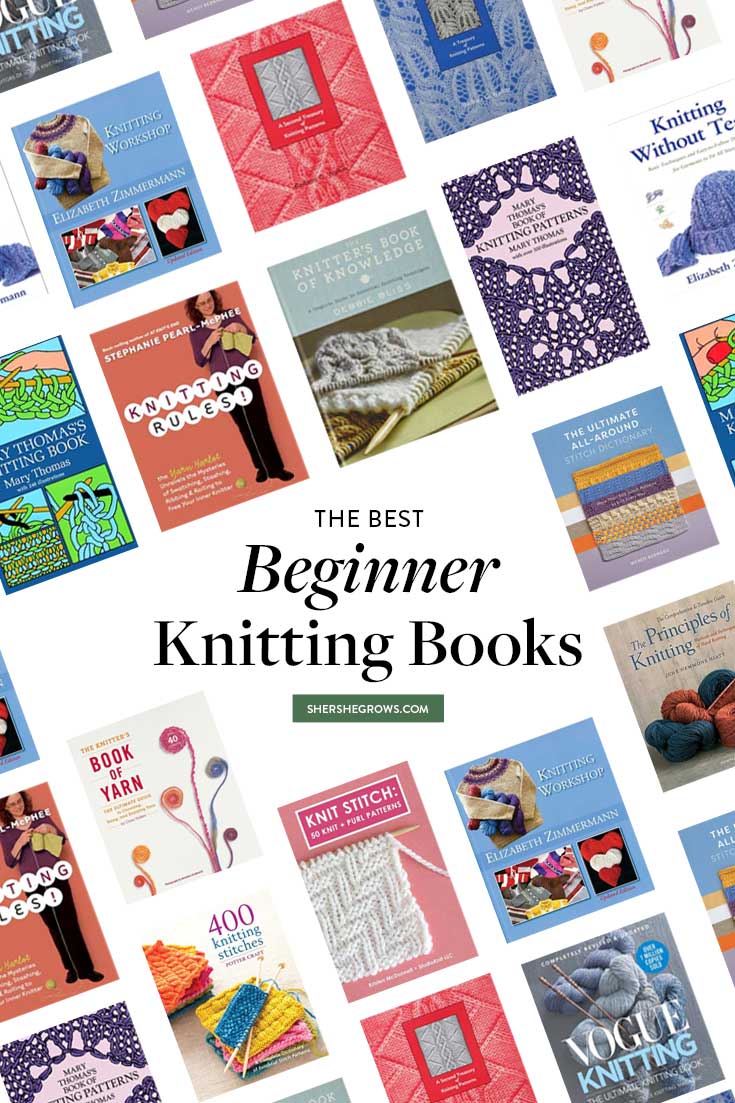
I’ve become obsessed with knitting.
And anytime I get really into a hobby, I like to learn as much as I can about it. I’ve accumulated quite the collection of knitting books as a beginner to knitting & fiber arts, so I wanted to share my favorites!
Beginner Knitting Books
- Best Coffee Table Knitting Book: Vogue Knitting
- Best Knitting Reference Book: The Principles of Knitting
- Best Classic Knitting Primer: Knitting Without Tears or Mary Thomas
- Best Modern Knitting Book: The Knitters Book of Knowledge
- Funniest Knitting Book: Knitting Rules
- Best Book to Understand Yarn: Book of Yarn
- Book Book to Practice Stitch Patterns: Barbara Walker, Knit Stitch or Potter Craft
Books vs Youtube
I’m very much a visual learner, so I often look up a specific tutorial on Youtube.
I think you can easily learn how to knit as a complete beginner just through watching free Youtube tutorials (for example, how to make a knit stitch, how to make a purl stitch).
So instead, I like knitting books as resource guides and reference books.
They’re great for presenting everything you want to know about knitting in a neatly organized book and I’ve learned a lot about specific techniques in each of them.
1. Vogue Knitting
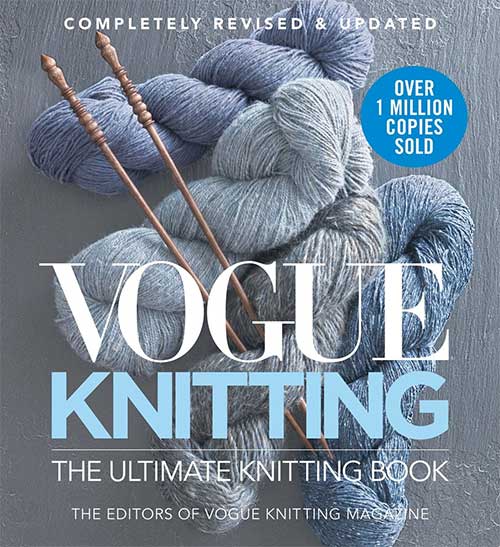
This is a massive hardcover knitting book that looks beautiful on a coffee table.
It’s written by Vogue Knitting Magazine (which sadly went out of publication) and covers everything you need to know to become a great knitter, starting from the very basics all the way through to advanced techniques.
I love that the chapters are color coded, with a helpful index at the back which makes navigation easy.
It’s kind of like a great overview knitting ‘bible’.
While you may eventually want to get more specific in-depth books (like on fair isle, making socks, knitting cables), I guarantee the Vogue Knitting book is the first you’ll reach for when you want to look something up!
2. The Principles of Knitting
by June Hemmons Hiatt
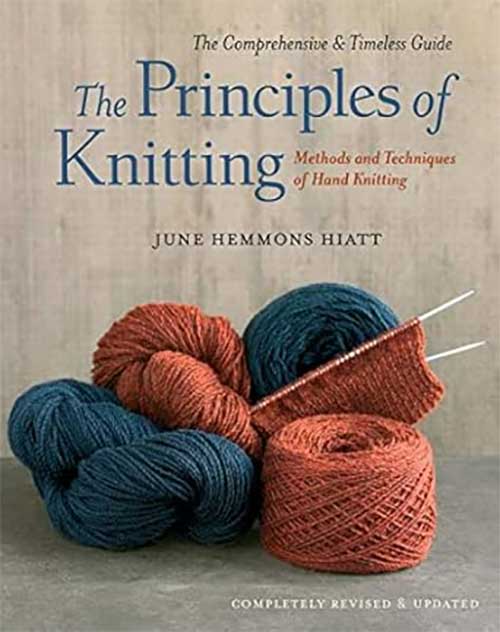
Along with the Vogue Knitting Handbook, this is my other knitting ‘textbook’.
The Principle of Knitting is also a massive, comprehensive reference book that teaches you how to knit, covering everything from various cast-on techniques to stitch patterns, increases / decreases, finishing, etc.
If I had to compare the two, I’d say the Vogue Knitting Handbook’s pages are designed a bit sleeker and more modern.
The Principles of Knitting book is more like a college course textbook.
Both are all-in-one tomes with extensive knitting knowledge that you’ll want to always keep on your bookshelf to revisit anytime you have a knitting question.
In particular, I found the section on picking up stitches especially helpful.
The first sweater I knit, the Lakes pullover, calls for picking up stitches so many times and my first attempts were a little messy and uneven until I read Hemmons Hiatt’s instructions.
I also earmarked the design section on modifying knits to create professional looking results for when I advance enough to be able to make my own sweaters!
3. Knitting Without Tears
by Elizabeth Zimmermann
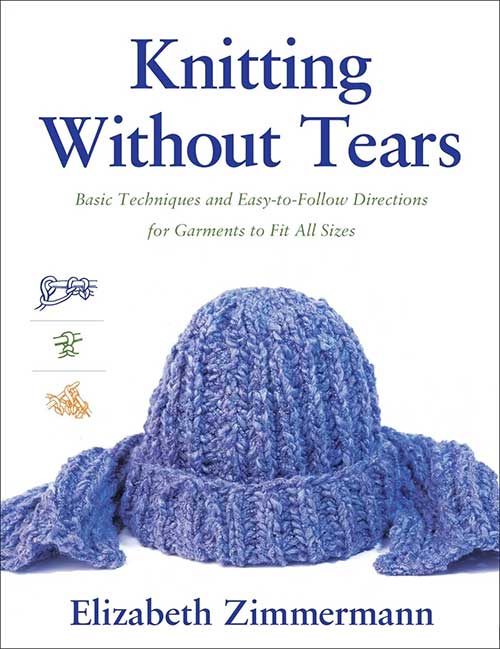
Reading Elizabeth Zimmerman’s Knitting Without Tears was like having a grandmother sit next to me teach me how to knit.
This book is a classic and the paperback looks like a volume from the 60s, ha.
This is a fantastic beginner knitting book and one that I return to every couple of months.
Every time I understand her lessons a little better!
Elizabeth Zimmerman is the Grand Dame of the American knitting world, famous for her knitting newsletter and PBS knitting show during the 1950s – 60s.
She approaches knitting in an approachable, easy to understand manner and has a huge technical repertoire, but she’s also quite opinionated.
While the format of the book is a bit old-school, especially compared to more current books, I found it incredibly helpful and took tons of notes in the margins.
(For some strange reason, the margins are extra wide in this printing)
Knitting Without Tears starts with beginner basics: different needle types, how much wool to buy for a project, the importance of gauge, etc.
The back half covers more advanced topics like shaping sweaters, applying logic and common sense and how to really make a knitting project your own.
The last third of the book contains patterns for various sweaters (a ski sweater, seamless yoke sweater seamless raglan sweater, etc) and various accessories.
What makes her patterns unique is that it’s less of a written step-by-step instruction and more of a formula – she basically invented the % method for knitting sweaters.
It’s a very informative approach because it teaches you about sweater construction and garment formulas so you understand the rationale behind sweater design.
Elizabeth Zimmerman is really who we have to credit for top-down sweater construction.
Traditionally, sweaters were knit bottom up and in pieces, with the body separate from the sleeves, and then stitched together at the end.
She popularized top-down design – which practically all the popular knitting patterns today now use.
In fact, if you scroll social media and see any person under the age of 40 knitting, chances are they’ve only knit top-down sweaters.
I didn’t realize that she invented this method when I read her book the first time.
Now that I’ve re-read it, some of her comments make a lot more sense, ha.
She was quite opinionated and really hated seaming garments together (which is more of a sewing technique).
She also thought sweaters didn’t need seams for structure and her top-down yoke design approach really was quite revolutionary for her time.
Finally, I really recommend this book because Zimmerman explains how she experimented a lot and didn’t listen to ‘traditional’ advice.
For example, she finds needle size a bit fungible and will even knit socks on different size DPNs.
When I made a couple Tiktok videoes on this and tried it out, using two different needle sizes to knit sleeves, I got some pushback ha)
But her opinion actually turned out pretty accurate!
So she’s definitely taught me to be much more experimental with my knitting.
4. Elizabeth Zimmermann’s Knitting Workshop
by Elizabeth Zimmermann
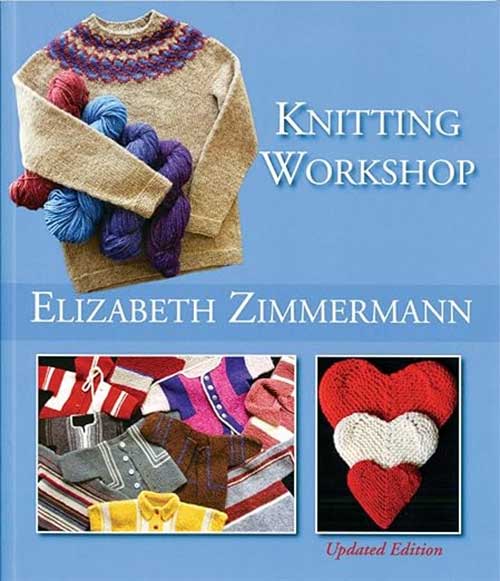
I really enjoyed Elizabeth Zimmernan’s common sense approach to knitting, so I also got her second book.
The Knitting Workshop is the book version of her popular PBS television series.
It guides you from beginner to master knitter, with all of her innovating knitting techniques and construction methods.
It also includes several of her most popular patterns, like the Baby Surprise Jacket – a legendary baby sweater knit all in one garter stitch piece with only 2 seams.
Elizabeth Zimmerman was born in England, then attended art school in Switzerland and Germany before immigrating to the US in 1937.
She started her own knitting newsletter due to her frustration with magazine editors, who were constantly abbreviating her conversational knitting instructions into more print-friendly shorthand.
So expect an old-school black and white book, written in a conversational tone.
She comes from a time when knitting techniques were passed down from family member to family member, so I found all of her insights very interesting!
She really teaches you fundamental knitting concepts. I’m still at the stage where I buy patterns and follow the steps almost exactly as written.
But now having read her books, I feel like I better understand knitting techniques (when to use this type of increase over another) and her percentage formula for knitting sweaters is genius (I’d love to be able to self-design my own patterns some day).
Personally, I think there’s a benefit to having both modern, colorful, picture-heavy knitting books and old school knitting fundamental books.
The modern books really walk you through all the details while the older books are light on the individual steps but teach you how creatively think about knitting so you understand the ‘why’.
Buy on: Amazon
5. Knitting Rules! The Yarn Harlot’s Bag of Knitting Tricks
by Stephanie Pearl-McPhee
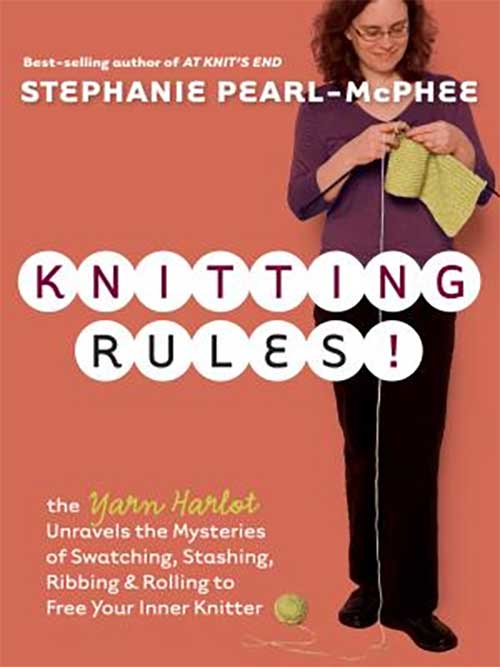
If you love books, this is the kind of knitting bible you’ll want to get.
It packs so much great information in a fun and practical format.
Stephanie Pearl-McPhee dives into the why behind everything knitting related: why yarn gets tangled, why swatches are the foundation to knitting, etc.
She also guides you on how to knit hats, scarves and socks without a pattern.
She provides recipe formulas so you learn how to fine tune your knits for your own specific measurements, instead of slavishly staring at charts.
And best of all, she’s incredibly funny. She’s the most down to earth, hilarious knitting instructor of this list!
I usually read physical books.
But Stephanie Pearl-McPhee is such a great public speaker that Knitting Rules! is one I’d also recommend in the audiobook format.
6. The Knitter’s Book of Yarn
by Clara Parkes
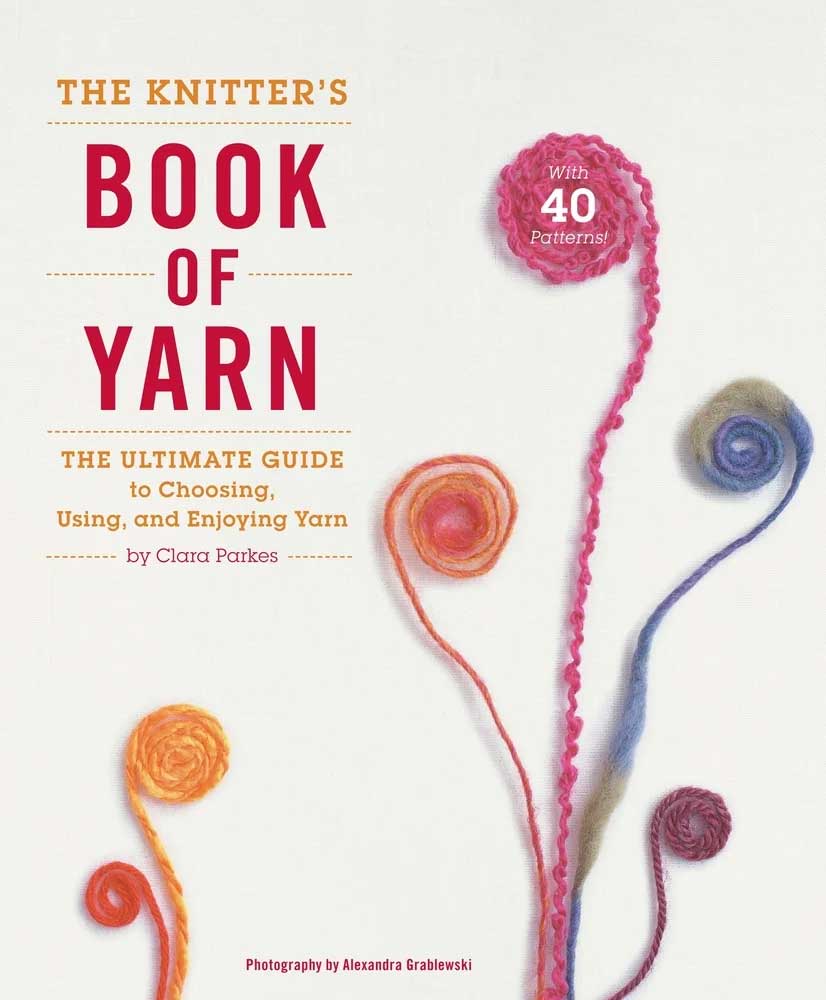
There are 2 kinds of knitters: those who find a pattern they like and then choose a yarn…
….and those who fall in love with a yarn and then look for a pattern to use it in.
Both types of knitters are focused on half the equation. The Book of Yarn helps bridge the gap!
Clara Parkes goes in-depth about yarn, breaking down various fiber types, preparations, spins and ply combinations so that you can truly understand what specific yarns are good for and how they’ll affect the resulting finished object.
When I decided to knit my first sweater, I spent a week just researching which yarn to buy – I would have saved so much time if I had gotten this book first!
The first half of the book focuses on yarn characteristics while the second half has patterns that highlight the particular properties of different yarns.
Personally, I’m always striving to make my hand-knit items look as good as store bought and I’ve come to realize that a huge part of that is the yarn.
I still read yarn reviews on Ravelry, but I have a much better grasp on buying yarn after getting this book.
Especially in today’s world of shopping for yarn online, understanding the right type of fiber, ply and spin for your project goes a long way. I also have a much better grasp on substituting yarn!
7. Mary Thomas’s Knitting Book
by Mary Thomas
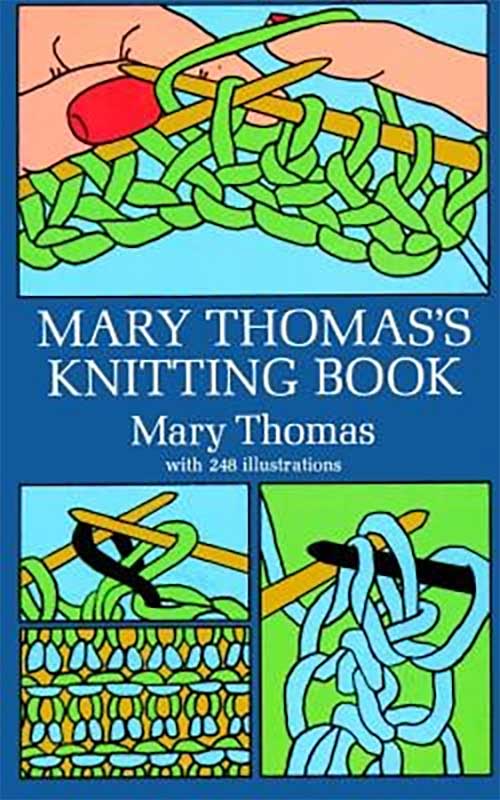
Originally published in the 1930s and still a classic today, Mary Thomas’s guide is the kind of book that turns beginners into confident knitters.
Her explanations of foundational techniques are clear and surprisingly modern, and she teaches the “why” behind knitting so you build real skill from the start.
This book is like having your own private instructor, clearly and definitively explaining various methods and stitches.
There are also sidebar illustrations to accompany the instructions.
I really liked that she covered the early origins and history of knitting. Everything was written conversationally (so it wasn’t boring) and it gave me a lot more insight into how knitting came to be.
I also thought she had helpful tips sprinkled throughout the book – I read this in ebook form on a 15 hour overnight flight to Asia and kept screen shotting the pages!
Overall, it’s a very concise, compact book for beginners.
At just 256 pages, it packs a treasure trove of great knitting information and has excellent patterns (well-written and error free – I can’t say the same for all modern knitting books)
8. Mary Thomas’s Book of Knitting Patterns
by Mary Thomas
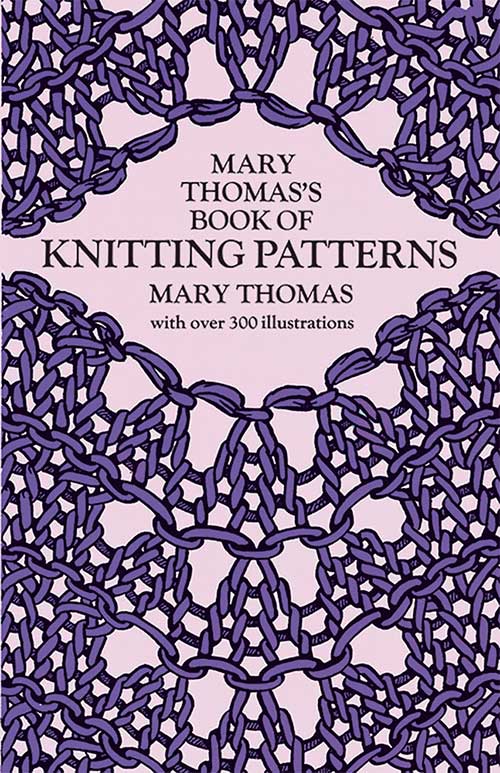
Once you’ve learned how to knit and purl, it’s time to start playing with textures.
Mary Thomas’ Book of Knitting Patterns is the perfect companion book – it’s like having an old-school stitch mentor by your side as you learn various new stitches.
I found the book very well organized and all of the patterns beginner friendly.
The stitch patterns start out simple, then gradually grow more elaborate.
Along the way, there’s lots of clear instruction and illustrations so that you can start to see the orderly scientific methods upon which knitting patterns are based.
If you eventually want to modify patterns to suit your own tastes, this primer gives you the knowledge to do so, by explaining the how and why of specific patterns.
It’s a soft cover, easy to flip through book in black and white. All of the charts and pictures are really well laid out.
9. The Knitter’s Book of Knowledge
by Debbie Bliss
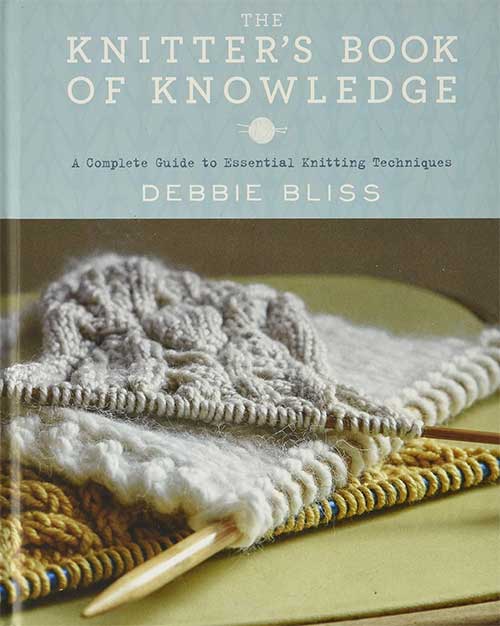
I’ve already recommended two knitting ‘reference’ type books, but I couldn’t resist adding this third and final resource: The Knitter’s Book of Knowledge.
It covers everything you need to know about knitting – from choosing yarn to casting on.. to shaping, embellishing, colorwork and finishing.
The book is high quality, with thick paper and color illustrations. The directions are clear, there’s lots of helpful hints and the photos and drawings that illustrate the techniques are the best I’ve seen.
I especially loved the diagrams – they were clear, easy to read and printed in color. This is the modern knitting bible if old-school black and white photos aren’t for you.
In particular, I found chapter 10 on designing knits really interesting. Debbie Bliss walks you through, step-by-step, how to develop a design.
I also refer to chapter 11 on Troubleshooting quite often. She goes beyond the typical ‘how to fix a dropped knit stitch’ and shows you how to fix extra stitches, correct cable patterns, mend holes and shorten or lengthen knit fabric.
I didn’t realize you could completely shorten or lengthen sleeves without undoing the ribbed cuff!
If you’re a brand new beginner, this book has the best diagrams i’ve seen for how to make a knit stitch and purl stitch.
There are instructions and illustrations for knitting english, knitting continental as well as making a knit stitch when you’re left handed.
I’ve bookmarked the chapter on colorwork to come back to it when i’m ready to try it! At a quick glance, it delved into color theory, how to read charts and catching floats.
Overall, this is a beautiful, high quality reference book that I know I’ll return to again and again!
Buy on: Amazon
10. A Treasury of Knitting Patterns
by Barbara G Walker
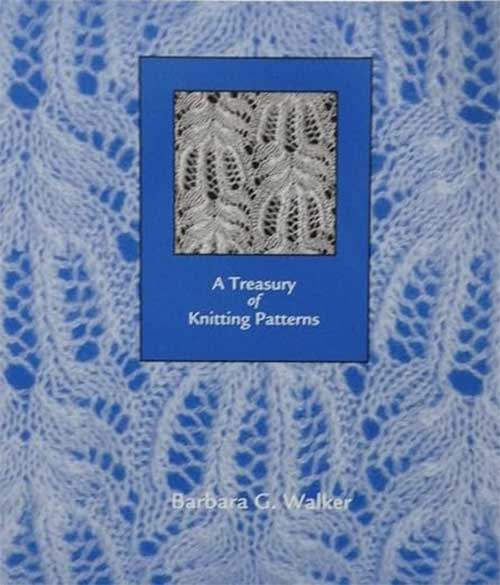
Barbara Walker is the OG of stitch dictionaries.
Her book A Treasury of Knitting Patterns is a 4-volume set, but in particular I recommend the first two.
Inside there are SO many different patterns – lace, edgings, cables, brioche, herringbone etc.
She explains each pattern very clearly, and also gives helpful information on each one so you have a better idea how to use them in an actual project.
For example, she’ll note which stitch options can achieve various effects: thinner, thicker, fluffier, denser, non-stretchy etc.
This first volume is the most beginner friendly book in the set, with lots of basic stitches.
Some modern stitch dictionaries also showcase lots of interesting stitch patterns, but when you go to try them out you realize they haven’t been proofread and their patterns don’t work properly.
Not so with Barbara Walker’s.
This book is a classic – every pattern I’ve tried has worked beautifully.
Note: most instructions are in written form, no charts and the book is in black and white.
Buy on: Amazon
11. A Second Treasury of Knitting Patterns
by Barbara G Walker
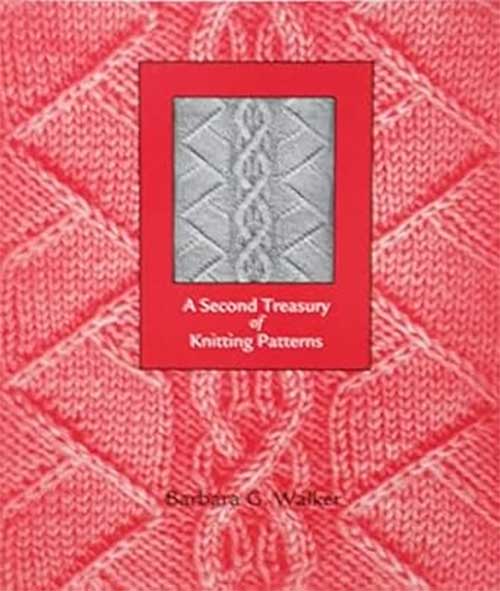
In her second book, Barbara Walker dives more deeply into patterns – yarn overs, increases, decreases, combinations, cables, lace, etc.
It’s the perfect stitch dictionary to transition from beginner to intermediate.
Eventually, I’d love to incorporate some of these stitches into modifying sweater patterns.
As in her other books, these photos are all in black and white. Personally, I don’t mind that as it removes the focus away from the yarn and lets you focus on the pattern itself.
All of the photos are very clear and easy to read. Ms. Walker knitted all of the swatches herself!
For many of the cable patterns, she shows multiple patterns in the same swatch so you can get an idea of how they combine together.
There’s also a lot of focus on lace – with chapters for borders and edgings.
Overall, the patterns are interesting, usable and interesting!
Buy on: Amazon
12. Knit Stitch: 50 Knit + Purl Patterns
by Kristen McDonnell
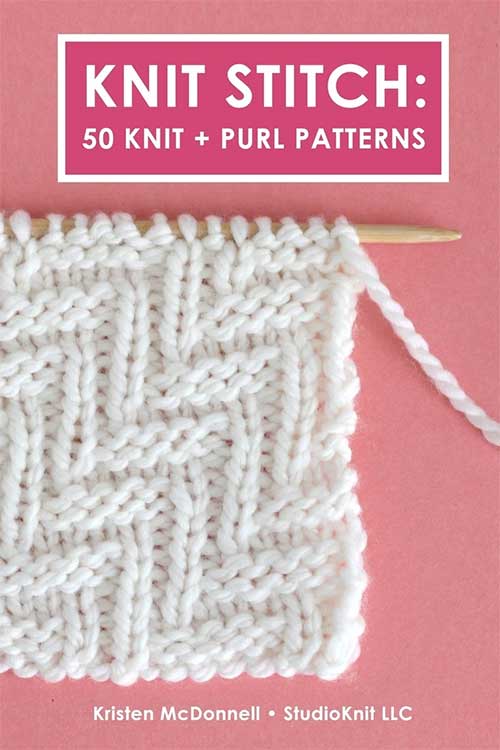
As a beginner, I’ve found stitch dictionary books quite helpful.
This one uses just the 2 foundational stitches, knit and purl, and shows you 50 unique designs so you can see the full range of fun possibilities that result from just the 2 basic stitches.
The patterns inside are simple and modern. Each has well-written instructions to guide you through stitch-by-stitch.
The chart diagrams are clear and beginner friendly and I appreciated that she includes both for knitting flat and in the round.
This book was created by YouTube Kristen McDonnell from the knitting channel Studio Knit.
Because she’s a Youtuber, this book is unique in that the author also created video tutorials for each pattern on her website! Her voice and mannerisms are quite easy to watch and learn from, and she’s an excellent resource to learn from.
Buy on: Amazon & Bookshop
13. 400 Knitting Stitches: A Complete Dictionary of Essential Stitch Patterns
by Potter Craft

Every knitter needs a good dictionary of stitches.
This book is basically an encyclopedia of stitch inspiration.
It’s divided into 8 categories:
- knit-purl
- crossed and cables
- slipped
- lacy
- double
- twisted
- cast-off
- fancy stitches
Whether you want to make a lacy shawl or a classic cabled sweater, you’ll find the stitch in here for your project.
Each of the 400+ stitches has easy to follow written instructions, a close-up color photo so you can clearly see what the stitch looks like and a chart.
Plus, I actually like most of the stitch patterns. There’s lots of variety and plenty of modern designs I’d actually want to use.
This is perfect as both a reference stitch dictionary and also for sparking creativity.
14. The Ultimate All-Around Stitch Dictionary
by Wendy Bernard
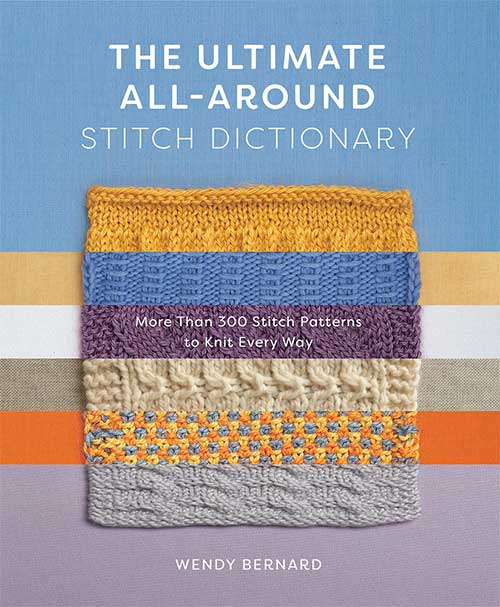
And finally, I have one more stitch dictionary type of book to recommend.
The Ultimate All Around Stitch Dictionary has tons of stitches to spark your imagination.
What makes Wendy Bernard’s book unique is that she provides instructions both for knitting flat and in the round. She shows you each stitch bottum up and top down.
Most vintage sweater patterns are knit bottom up, and often knit flat and then seamed.
If you prefer the more modern trend of knitting sweaters top down, and in the round, then this book will guide you on how to work patterns in your method of choice.
Plus the photos inside are excellent.
All of these titles are trusted, time-tested and well loved.
As someone with very little space in my NYC apartment, I only buy books that I really love or will return to again and again. For knitting, that’s mainly resource books and stitch dictionaries!
If you have any knitting books you love, let me know in the comments!
Follow me on
Youtube | Tiktok | Instagram | Ravelry | ShopMy


