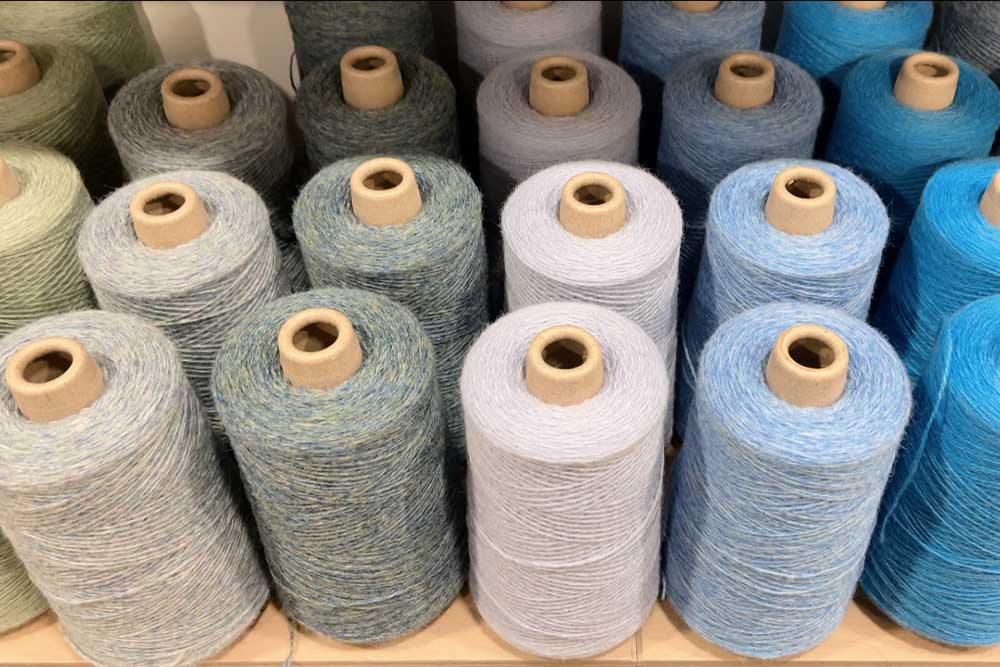
Lately, I’ve been fascinated by cone yarns.
I got into knitting with the goal of making my own ‘capsule wardrobe’ – handknit sweaters that look store bought.
Basically, instead of buying my usual designer cashmere sweaters, I’d love to be able to hand knit them. At the time, it seemed very doable to my naive, beginner knitter brain.
Most designer sweaters are very simple silhouettes after all, usually plain stockinette with some ribbing at the cuffs and hems.
I’m talking sweaters like The Row Ophelia or the Khaite Mae.
But as I’ve been knitting more and more, I realized I needed to find better yarn to to achieve the plush, high end fabric (usually cashmere and merino).
Enter: cone yarn.
So today I wanted to share my guide to unlocking cone yarn as a hand knitter.
I’ll cover my process of sourcing and buying yarn on a cone, the pros and cons of knitting with cone yarn and everything you should know to unlock these as a fun fiber source!
quickly jump to:
- What is Cone Yarn
- Pros of Knitting with Cone Yarn
- Cons of Knitting with Cone Yarn
- Where to Buy Cone Yarn
What Is Cone Yarn?
Cone yarn is simply yarn wound onto a cardboard or plastic cone.
Most yarn sold at yarn shops or aimed at hand knitters is wound into balls or skeins.
But commercially, the textile industry works on cones.
Weavers, machine knitters and mills prefer cones because the yarn feeds smoothly and consistently, and because cones can fit an enormous amount of yardage onto one package.
Cones can range from ~200 grams all the way up to 2 kilograms (or more!).
follow me on Instagram @madeby_sher for more knitting content
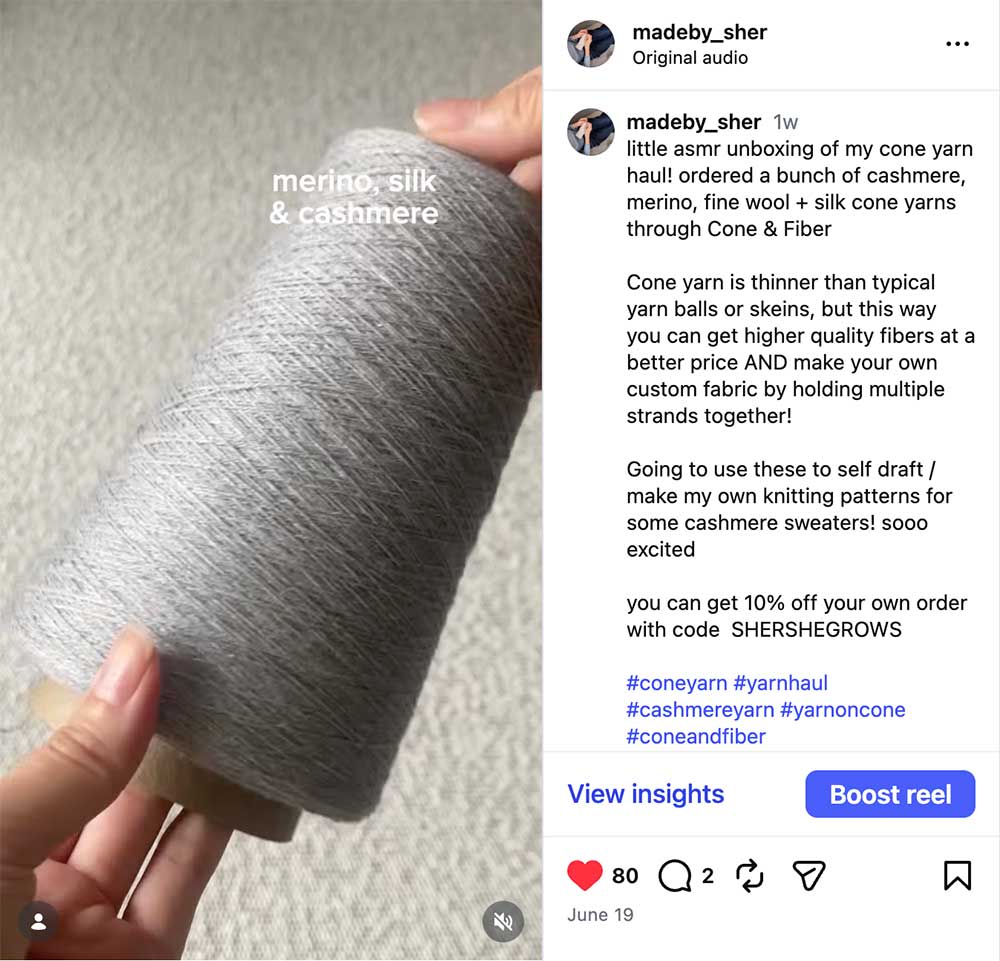
some examples of cone yarns in beautiful fabrics I wouldn’t be able to get ahold of in regular ball-form!
A single cone of fingering-weight yarn might contain 4,000 yards. To put that in perspective, a standard 50g skein of sock yarn usually gives you around 200 yards.
So one cone can hold the equivalent of 20 skeins.
The best part?
Yarns sold on cones are often higher quality yarns used by mills and designer textile manufacturers.
You’re getting a more budget-friendly price and you’re also getting higher quality fibers, direct from the source.
The Case for Cones
When I first learned about cone yarn, that part alone sold me.
I’d say 90% of my winter sweaters that I’ve bought are cashmere. I have sensitive skin, I run cold and I’m very much a ‘quality over quantity’ person.
I’d rather have 4 really beautiful sweaters that I wear for decades instead of buying 5 sweaters every season made from unbreathable, un-insulating polyester.
So it was a little frustrating to me to be spending $100-200 on a sweaters-quantity of scratchy wool balls from the popular commercial yarn brands.
Because at that price.. it’s more economical to just buy a beautiful designer cashmere sweater for $200-400 and save the time and effort of knitting!
Plus at least I’d know the fit is perfect and the quality impeccable.
(Some of my favorites for thick, plush, scrumptious cashmere are Theory, Toteme, The Row, Khaite. I pretty much always get them on sale.)
Don’t get me wrong, I find joy in the act of knitting, but I’m very much a project knitter.
Also at the risk of sounding like a snob, I just prefer cashmere. Scratchy Peruvian and Norwegian wool just do not compare.
With cone yarn, you’re primarily selecting based on the fiber content.
It ends up being quite affordable to source cashmere, extra fine merino, yak and other premium & unique fibers.
Better quality and better pricing?
It just makes sense ✨
What’s the Catch
Of course there’s a catch… right?
Since cone yarns are primarily created and sold to industrial mills, they’re not as easy to get a hold of as a plain ol’ regular hand knitter.
They also use an industrial labeling system that’s very different from the fingering / DK / worsted or gauge terminology you’re likely familiar with (more on this below).
It makes it a bit difficult to source, confusing to sort through the options and overall a not-as-simple experience to shop for cone yarns as a beginner. I list some shops to buy cone yarn later down in the post.
First, let me fully explain the pros and cons of cone yarn.
Understanding Cone Yarn
Cone yarn is the fiber that’s been powering professional textile studios for decades.
It’s not as accessible to hand knitters (very much a ‘if you know, you know’), but once you understand how it works, it opens up a whole new world of quality, variety, and value.
I would recommend cone yarn for intermediate knitters, not beginners.
I think it’s helpful to already be comfortable reading patterns, that you understand gauge, and that you have experience knitting with more than one skein of yarn at the same time.
What you may not be as familiar with is how cone yarn behaves differently from the skeins and balls you normally buy, and what you need to do to get the best results from it.
Let’s dive in!
Benefits of Hand Knitting with Cone Yarn
Cost per Yard is Dramatically Lower
The retail yarn you buy at a yarn shop has been through a lot before it reaches you: it’s been de-oiled, dyed, skeined, labeled, packaged, and marketed.
Part of the markup with buying balls, skeins or hanks of yarn at yarn shop aimed towards knitters factors in all that processing, on top of the fiber itself.
Cone yarn comes to you in a much more raw state.
It’s still in its original package, often still carrying spinning oil and in the large quantities the industry uses rather than the small, pretty portions retail buyers expect.
When buying cone yarn, you’re essentially saving money by doing some of the finishing work yourself.
Let’s look at the numbers:
When you buy a cone of merino, you might pay $25–$40 for 3,500–5,000 yards.
If you were to buy the equivalent yardage in retail skeins and, you could easily be looking at $80–$150+.
Buying cone yarn is roughly 25-40% cheaper.
For knitters who make a lot of garments, or who like to swatch generously and not stress about running out, the economics are hard to argue with!
Access to Professional Grade Yarn
Often we think cheaper = lower quality.
With cone yarns, it’s actually the opposite.
A lot of the yarn sold in hobby shops is specifically produced and priced for the hand knitting market. The cone world operates at a different level entirely.
The commercial knitwear industry (like the mills supplying brands like Loro Piana, Brunello Cucinelli, Chanel, Zegna, etc) sources and spins its own yarns in fibers that simply never make it onto retail shelves.
For example, fine merinos, high-twist wools built for colorwork, pure silk, Sea Island cotton, linen singles, qiviut, camel down, yak, baby alpaca, Tencel, etc.
These mills exist largely out of sight, selling exclusively to the garment trade.
But when a production run ends or a brand doesn’t take its full order, mills often offload the surplus to yarn dealers and indie retailers. That’s where hand knitters can access it.
With a little hunting, you can buy from the same supply chain that luxury fashion brands use, at a fraction of what the finished garment would cost.
A Sustainable Way to Shop
I love clothes and fashion, but I also hate overconsumption. The fact that buying cone yarn is a more sustainable way to knit is an aspect I really like.
A significant portion of cone yarn sold to indie makers is mill-end or surplus yarn. It’s essentially the leftover stock from fashion industry production runs.
When a clothing brand cancels an order, overestimates how much yarn they need for a season, or discontinues a colorway, that yarn has to go somewhere.
Historically, a lot of it ended up in landfills…
And with the fashion industry generating an estimated 92 million tonnes of textile waste every year, that’s not a small problem.
Buying mill-end cone yarn is a direct way to intercept that waste. You’re giving a second life to high-quality fiber that might otherwise never become anything.
It’s a bit like thrift shopping for your stash.
And I don’t know about you, but scoring beautiful, unusual yarns at low prices gives me such a thrill.
Keeping some of it out of the waste stream in the process is a nice benefit!
Consistency Across a Project
With a single large cone, dye lot anxiety disappears.
You’re working from one continuous supply, so there’s no risk of a slightly different batch showing up halfway through your sweater back.
Great for Colorwork and Stranded Knitting
Fingering and laceweight cones are particularly well-suited to Fair Isle and other stranded techniques, where you need lots of yardage in multiple colors without spending a fortune.
When I bought yarn for my Celeste sweater, a simple yoke colorwork pattern by Petite Knit, I was shocked at the project cost.
Even though you’re using very little of each color, you still need to buy at minimum 1 ball of each. At $11 a ball for Peer Gynt, it starts to add up!
Plus, then you’re left with 80% of each of the contrast color balls. It felt wasteful to me because I never quite know what to do with ‘scrap yarn’
Cleaner, More Continuous yarn
Mill-spun cone yarn is produced to run through industrial machinery without breaking.
It’s typically spliced and inspected for knots, weak spots, and thick/thin inconsistencies before it ever reaches you.
This translates to fewer interruptions while you knit.
That’s less stopping to deal with a random knot buried in your skein, fewer unexpected joins, and a smoother overall strand.
Your finished fabric benefits too, with less fuzz and pilling in the areas around joins.
Fewer Ends to Weave In
Cones pack a lot of yardage onto one core, so you could knit an entire garment without a single yarn join if you plan well.
No more hunting for buried tails at the end of a project, and no structural weak points where ends might work loose over time.
Blend Your Own Fiber
This is one of the most fun aspects of knitting with cone yarn.
Cone yard typically is very thin (much thinner than traditional balls of yarn) so you’ll likely hold multiple strands together to form a fingering, sport or DK weight equivalent.
You can combine 3-6 of the exact same strands… or you can mix and match!
Essentially, you get to create your own custom blend of fibers, colors or properties.
Want a silk-merino held double for a warmer gauge?
A linen-cotton blend for a summer tee?
A subtle tonal effect by combining two near-matching shades?
Love using mohair held double but are put off the by the cost?
Cones make all of this approachable and affordable in a way that skein knitting rarely is.
It also makes scrap yarn projects easier.
Leftover Yarn is Actually Usable
Personally, I hate orphan balls leftover at the end of project.
I’m always playing yarn chicken and buying 1 ball less than I think I need. Because my biggest pet peeve is opening up a new ball only to have 85% of it leftover!
Too little for another sweater… too much to throw away.
So cone yarns are a nice change!
Cone yarns are very fine strands. When working with yarn of different weights, the lowest denominator wins.
Basically, if you have a couple strands of fingering and then 1 strand of DK, 1 strand of worsted and 1 of Aran, you’re SOL.
But since cone yarn requires multiple fine strands together anyway, you can always ‘build’ your optimal fabric weight. You can’t ‘un-ply’ Aran to make it fingering.
There’s also endless easy and fun possibilities when working with scrap cone yarn.
Only have a little bit of 1 color?
Hold 2-3 strands of your largest color, then gradually swap in the smaller quantity of a different color, strand by strand as you work.
You’ll get a beautiful gradient or marled effect.
With cones, the math works in your favor. No more wrestling with a pile of odds and ends thatwon’t play nicely together.
Cons of Cone Yarn
There are some trade-offs to using cone yarn over traditional balls or skeins. While I consider it well-worth the effort, I wanted to mention all the potential downsides of using cone yarn.
I think it’s important to go eyes-wide-open before buying.
Cone Yarn is Finer Than What Hand Knitters Are Used To
This is probably the most important thing to know going in.
Unlike the DK, worsted, and chunky weights that dominate retail yarn shops, most cone yarn is sold at fingering weight or finer.
Honestly, a lot of it is much finer than that. So fine it looks like embroidery floss, ha.
It’s just how the industry works. Mills typically blend multiple strands together to create incredibly beautiful fine-gauge garments.
As a hand knitter, if you want to knit with cone yarn you’ll typically need to hold 3-4 (sometimes even 5 or 6!) strands together to hit a usable gauge.
I find it manageable but it does mean there’s some additional pre and post prep.
Winding is Non-Negotiable
With most industrial cone yarn, you’ll want to wind the yarn off the cone and into cakes first.
You absolutely need a swift and a ball winder, or the process will become a tedious nightmare of tangles.
Read more: Stanwood Ball Winder Review
Yarn is often sold in “weaving weights”
Cone yarns are frequently labeled using industry notation like 2/8, 10/2, or 3/12.
These numbers describe the yarn’s ply structure and weight per unit length and they’re like a completely foreign language to a hand knitter.
Learning to decode gave me a bit of a headache at first, I’m not going to lie. More on cone yarn terminology below.
Cone Yarns Come with Oil that Must Be Washed Out
Industry cone yarn typically has a mill finish.
This is an oil treatment that’s applied to smooth the fiber and help it run through machinery.
This makes cone yarn much thinner at first impression. You could have the same yarn, one in a ball and one in a cone, and the latter in the cone will look thinner.
It’s because the oil significantly compacts and tightens up the strand.
This means you absolutely need to make a gauge swatch and wet finish the fibers so that you can remove the oil and allow the fibers to fluffen up and bloom to their actual thickness.
Gauge Swatching is Non-Negotiable
I can hear the groans as I write this, ha.
Cone yarn is wound under tension and often compressed for months (or longer) in transit and storage.
The mill oils keep the fibers compacted, and the yarn will behave quite differently off the cone than it will after washing.
You have to the swatch, and then wet-finish your swatch (typically 2-3 soaks) to fully remove the spinning oils.
You’ll then measure the gauge swatch after blocking before starting your project.
Minimum Quantities Can Be High
Some mills only sell cones in sizes that might be more than you need for one project.
If you want just enough for a pair of socks, a 4,000-yard cone might feel like overkill, but I like to embrace this as an excuse to plan ahead!
As someone who knits just sweaters, cones are perfect for my needs.
One cone is enough for at least 1 sweater (sometimes 2!) or a short-sleeve top + small accessory.
It really depends on the shop though. Some allow you to purchase in grams, so you can buy exactly how much you need (with a small minimum order quantity like 50g).
Note: Some shops will charge you for winding the yarn onto cones.
Fewer Colorways
Cone yarn tends toward classic, utilitarian colors.
You won’t find much gradient or speckle territory here. If indie dyed color drama is your thing, cones might not be for you.
I also find that the color selection can be quite limited.
Since it’s leftover stock, you never know if it’ll be a neutral, easily adaptable white or something unique like apple green.
Color Bleeding
One thing to be aware of is potential color bleeding.
If you’re knitting with strongly pigmented cone yarns alongside light or white yarns, be aware that the mill oils can act as a carrier for dye pigment.
When the fabric gets wet for the first time, that pigment can migrate and stain your lighter yarn.
Again, always do a gauge swatch to test.
I usually stick to solid colors anyway, so I haven’t experienced this personally. I’ve heard that some people will add a splash of vinegar during the wet-washing process to prevent bleeding.
Stock is Finite. When It’s Gone, It’s Gone
This is especially true of mill-end and surplus cones.
Because you’re buying yarn that was overproduced or left over from a fashion run, there’s no reorder. If you fall in love with a particular cone and run short halfway through a project, you may not be able to get more.
Buy more than you think you need… then buy a little extra on top of that.
The surplus world rewards optimists with too much yarn far more than it rewards those who cut it close.
You Can’t Touch It Before You Buy It
Almost all cone yarn shopping happens online, which means you’re making decisions about fiber, texture, and color based on a photo and a description.
It can be risky, especially if you’re sensitive to certain fibers or have strong preferences about hand feel.
A merino that looks lush and soft on screen might feel scratchier than expected in person, or a color might read differently in person than it did on your monitor.
And usually, all sales or final (or the return shipping would be prohibitively expensive)
It’s worth going in with your eyes open. The first cone is always a bit of a leap of faith.
Understanding Cone Yarn Weights and Industry Notation
The biggest hurdle when getting into cone yarn as a hand knitter is the labeling system.
Here’s a quick overview:
The notation N/M means Number of plies / Metric count.
The metric count (M) tells you how many meters are in one gram of a single strand. So a “2/8” yarn has 2 plies and a metric count of 8, meaning each single is 8 meters per gram.
To find the total yards per 100g, you’d calculate: 8/2 = 4 meters per gram, so 100g gives you 400 meters (about 437 yards).
A handy rule of thumb: higher numbers = finer yarn.
Common cone weight equivalents for hand knitters:
- Laceweight → often sold as 2/18, 2/20, or higher
- Fingering/sock → often 2/8, 2/10, or 10/2
- Sport/DK → often 2/6, 2/5
- Worsted → often 2/4 or bulkier singles
When in doubt, check the yards-per-gram and swatch. And always swatch!!
Where to Buy Cone Yarn
Hand Knitter Friendly Cone Yarns
If the mill finish, industry notation, and multi-strand math of traditional cone yarn feels like a lot to take on at once, there’s a middle ground: cone yarn sold specifically for hand knitters by mainstream yarn brands.
These are the same yarns you already know and love, just packaged on a cone for volume pricing and convenience.
It’s actually how I first fell down the rabbit hole of cone yarn. I got a cone of Knit Picks palette and it got me hooked.
These commercial yarn cones are designed for knitting straight off the cone – no spinning oils, cryptic weight systems or multi-strand holding needed.
It’s a much more straightforward knitting experience, without the cake winding or post-processing, and gives you a volume discount!
Knit Picks Palette Cone
The beloved 100% wool fingering weight, available on a 500g cone in over 20 colors. Purpose-built for colorwork and Fair Isle, and a fantastic way to build a multi-color stash without buying 20 individual skeins.
Available on Knit Picks
Knit Picks Wool of the Andes Cone
Their worsted-weight workhorse, on a cone. One of the few options in this category that lets you knit single-strand at a standard gauge right off the bat.
Available on Knit Picks or Amazon.
Knit Picks Dishie Cone
Their kitchen and home décor hero, Dishie is a hardworking worsted weight 100% cotton yarn with a tight spin and high absorbency. The 400g cones are great for larger projects such as rugs, towels, throws, and even weaving.
Available on Knit Picks or Amazon.
Jamieson & Smith Supreme Shetland Cone
Straight from Shetland, this is a step up in fiber quality while still being hand-knitter accessible. Softer in the hand while keeping that characteristic Shetland structure. A beautiful choice for stranded yokes, colorwork accessories, and anyone who wants the real deal for a special project.
Jamieson & Smith 2 ply Jumper Weight Cone
The iconic J&S 2ply in a 500g cone – the equivalent of 20 balls! 100% Shetland wool in fingering weight, with the vibrant color palette and crisp stitch definition the brand is famous for. The go-to for traditional Fair Isle colorwork, and a brilliant way to build a colorwork stash without buying ball after ball.
Note: this yarn does carry a spinning oil and will bloom beautifully after washing.
Frangipani 5-ply Guernsey Wool Cone
Spun and dyed in Yorkshire from 100% British wool, this is the authentic yarn for traditional Guernsey knitting and it only comes on a cone. Five plies tightly twisted into a smooth, hard-wearing sport-weight yarn, available in 500g cones with around 1,200 yards.
If you want to knit a proper gansey or a structured outerwear piece, this is your yarn.
WEBS Valley Yarns
WEBS has an in-house yarn brand, Valley Yarns, that produces excellent cones at very reasonable prices. Think 2/8 merino, cotton, and blends plus lots of cone yarn for sock knitting.
This line is aimed at weavers but what’s helpful is WEBS clearly labels each product with information knitters understand!
Available on WEBS
Lily Sugar’n Cream Cotton Cone
The accessible entry point for cotton knitters. Widely available, worsted weight, 100% USA-grown cotton, and sold in 14oz cones. Not a luxury fiber but a fantastic everyday option for dishcloths, market bags, and quick summer projects.
Available on Amazon
If you love knitting colorwork, or want to ease into the world of cone yarn, I would recommend starting with these first before diving into the industrial mill cones.
These come in a better range of beautiful colors and are ready to knit with, straight off the cone.
Plus, with these you won’t have to worry about color bleeding.
Where to Buy Industrial Mill Ends
Colourmart: one of the most popular and well-known sites, based in the UK. They have a constantly rotating, vast selection of Italian mill ends with rotating monthly sales.
You can sign up and get 20% off your first month’s order here by citing me (sherershegrows@gmail.com) as your referral.
Cone and Fiber: a Portland, Oregon based yarn specializing in yarn on a cone. They’re a newer, women-owned shop and I love having a US-based option!
In particular, I like how they have more ‘wearable colors and more handknitter-friendly product listings, that guide you on the # of strands and gram estimations.
You can get 10% off your order here with code ‘SHERSHEGROWS’.
Etsy: goldmine for partial cones at lower prices, though it takes a bit of sorting. Here are some shops known for their cone yarns:
- European shop: lots of merino,cotton, linen and fun options like boucle & angora
- Lithuanian shop: very popular, great range of linen, merino and cashmere
- Canadian shop for cashmere and silk blends
- Bulgarian shop for fun exotic fibers like cashmere, angora, silk and yak
- Latvian shop popular for its affordabe merino yarn cones
- European shop with a wide range of colors, cones and small blend bundles
I’ve also found that yarn shops in Korea tend to predominantly sell cone yarns. I highlighted some of my favorite yarn shops in Seoul in this post.
Read more: The Best Yarn Shops in Seoul
Finding this post helpful?
Support me by buying me a coffee on Ko-fi!
My Recent Cone Yarn Order
When shopping, look for cones that list yardage clearly (not just weight), fiber content, and care instructions.
Fiber content is especially important.
A lot of industrial cones contain fibers like acrylic, viscose, or nylon blended in percentages that aren’t labeled the way retail yarn would be.
Good retailers aimed at hand knitters will spell this out. Be cautious with unmarked industrial cones from Etsy or eBay.
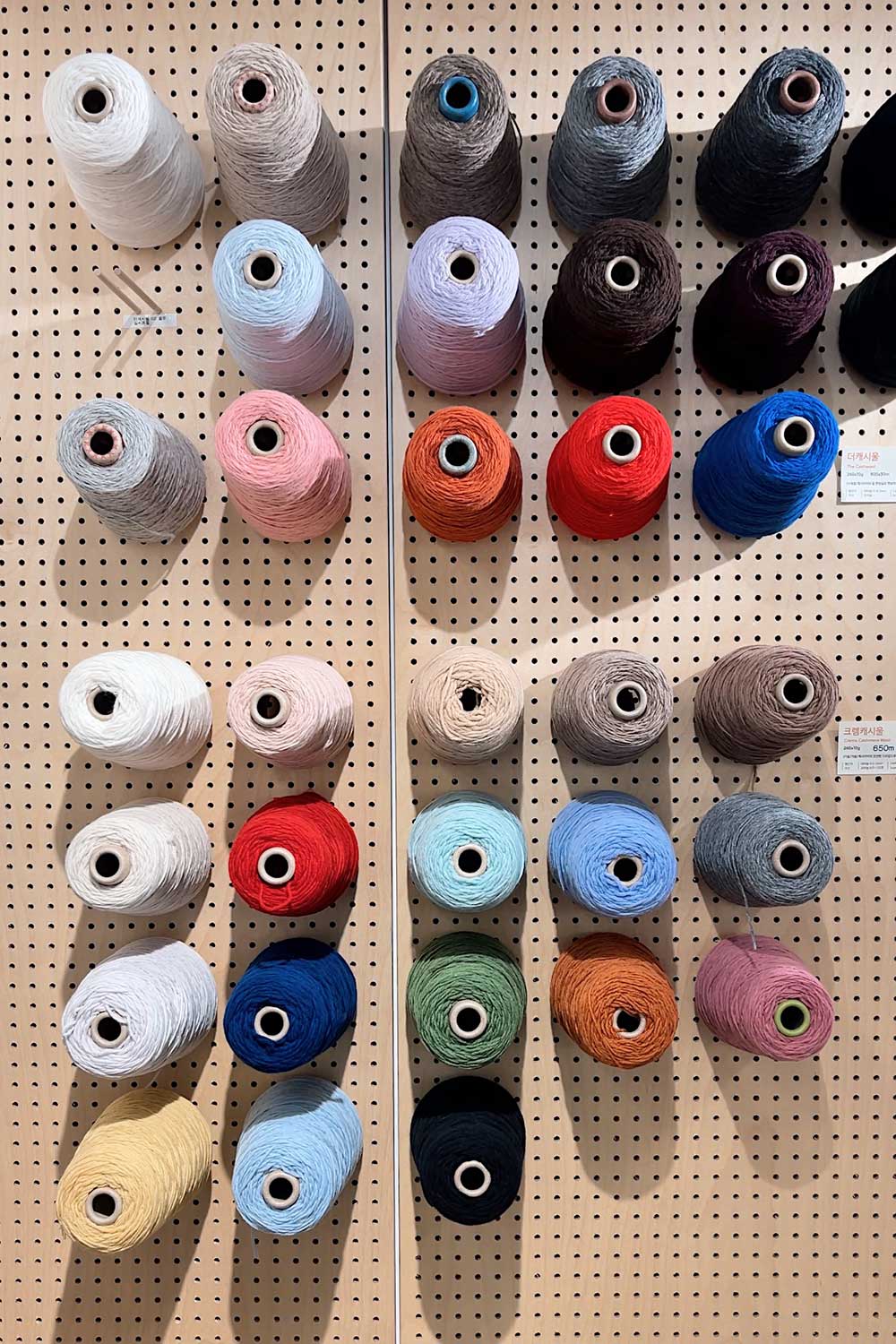
I hope I’ve convinced you to give cone yarns a try.
It’s opened up a whole new would of knitting for me!
I’ll be writing a series on cone yarn. Next up: the process of getting it off the cone and onto your needles.
A swatch of cone yarn is going to behave differently than you’re used to due to the spinning oils, so I’ve shared some tips here.
Read part 2 here, where I cover everything you need to know about winding, swatching and washing cone yarn in part 2.
Subscribe to get notified when future posts in the series drops!
Follow me on
Youtube | Tiktok | Instagram | Ravelry | ShopMy


